Conjuring Genus Loci
Fall is a joyful season for me, and this past October especially so.
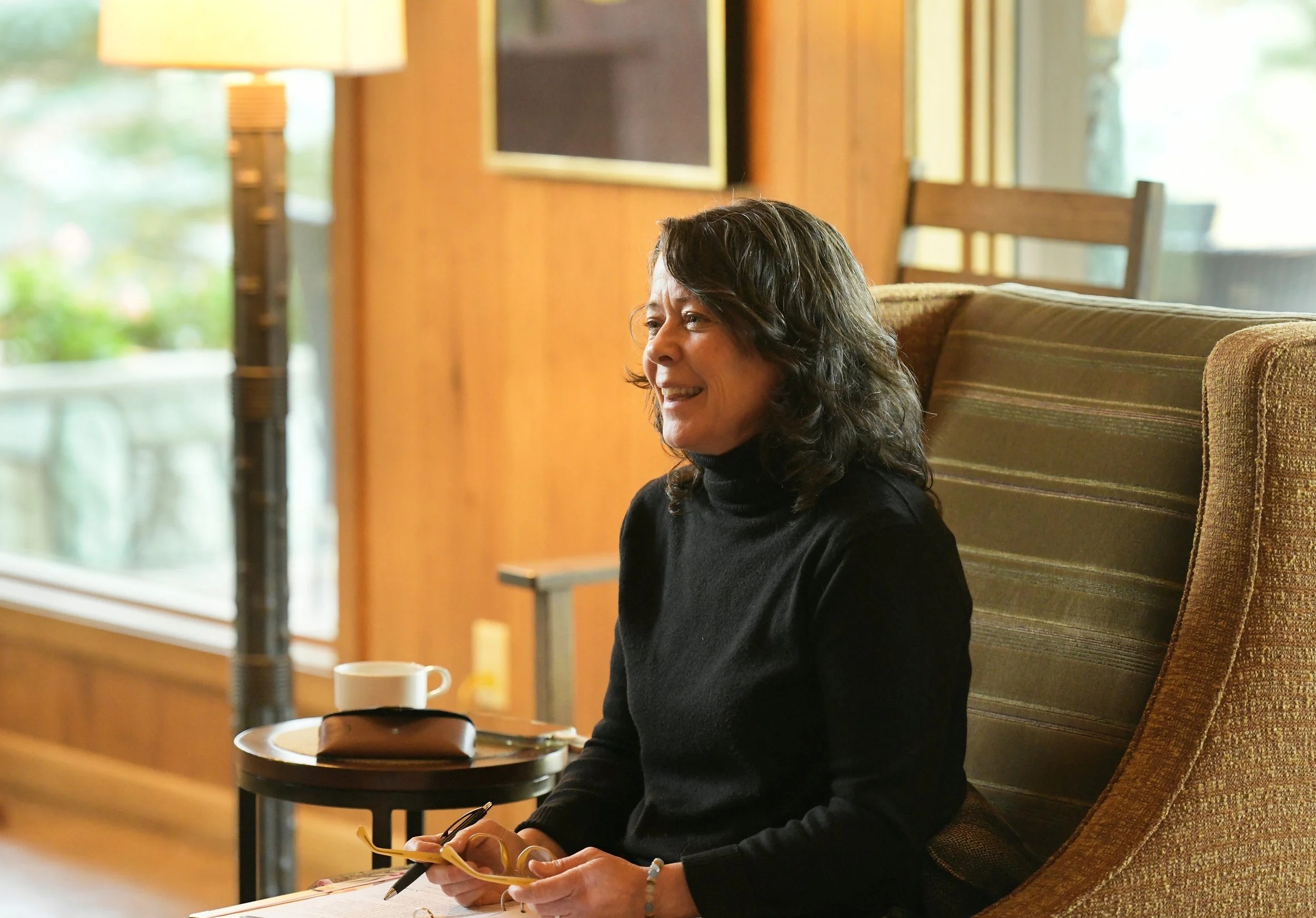
That’s because I was invited to lead a writing workshop at House on Metolius, a truly magical place. Writing retreats are a rare animal wherein things turn inside out. Instead of talking about something already written, the question becomes how to talk about how to write? It feels strange, like brushing your teeth with your left hand (if, that is, you’re a rightie.)
The setting couldn’t have been more perfect for a fall gathering. House on Metolius sits on the bank of that eponymous river surrounded by huge ponderosa pines. The property, two hundred private acres adjacent to millions of acres of national forest, has been a beloved retreat for more than one hundred years. The current house was constructed in 1958-59 by Portland Architect R. D. Kennedy, of Regal Building by the grandfather of the current owner, Tor Lundgren. It’s a single story, with one long wing housing the guest rooms and the other a grand living room. A dining room and cozy sitting room share the middle of the house with the kitchen. The interior design has signature Pacific Northwest warmth with palpable Scandinavian hygge. Behind the house, a lawn and stone patio overlook a broad meadow, the river, and Jack Creek curving toward the mountains. Carved stone steps descend to a path, and a wooden bridge leads to several small cabins set under the trees.
We gathered the first morning in the living room in front of the massive stone fireplace.
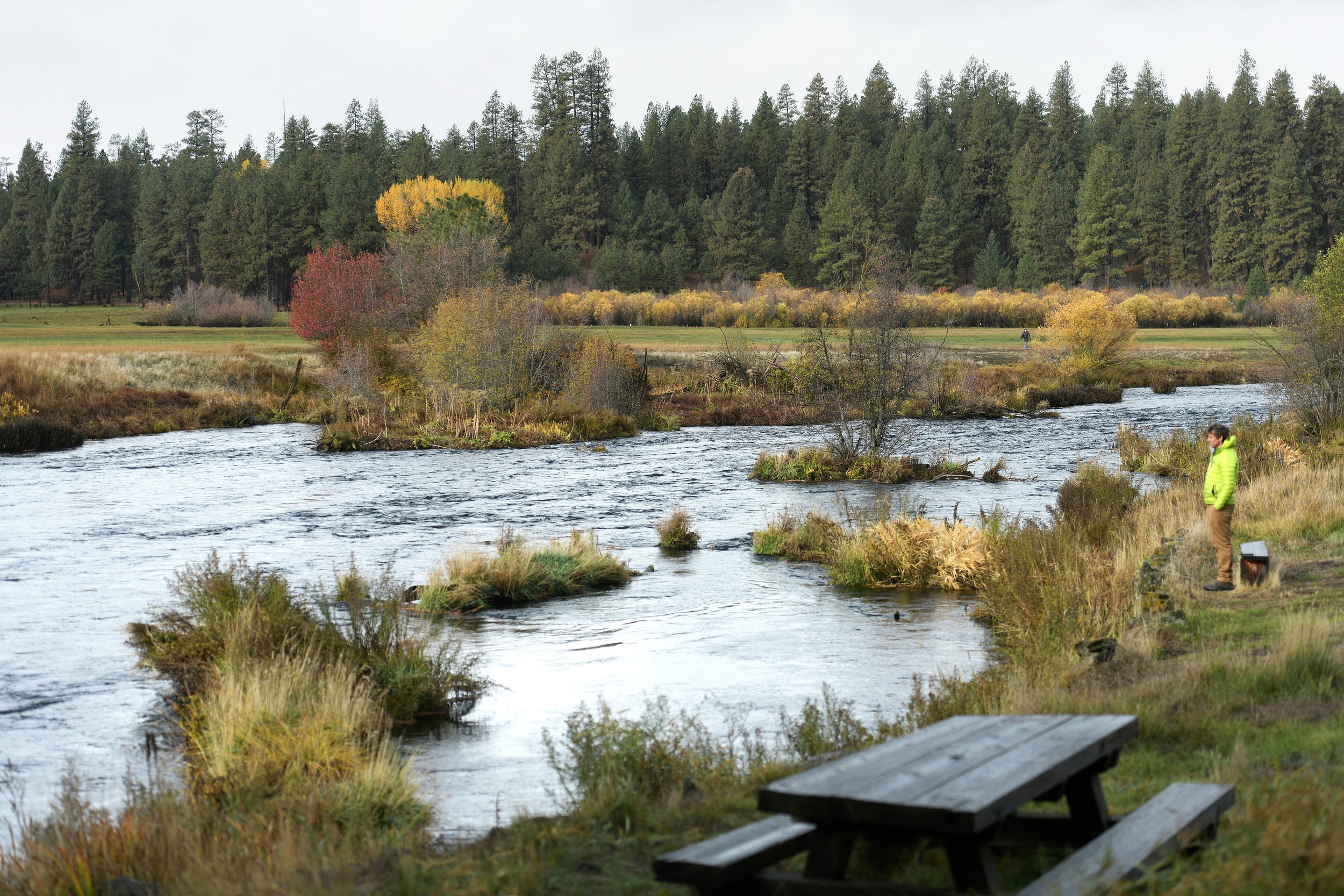
The windows revealed a stormy sky changing by the minute. To start the conversation, I introduced the idea of genus loci, which I’d first heard about in a TED Talk from author Elizabeth Gilbert. Gilbert explained that ancient Greeks and Romans believed artistic genius was not attached to a person, but rather to a place. Each locale had a resident spirit that helped the artist create. Gilbert joked that it took the pressure off; if your work wasn’t so hot you could blame it on a lazy genus loci.
I’d also heard the poet David Whyte reference genus loci in an interview with Krista Tippet. He said this: “In the ancient world, the word ‘genius’ was not so much used about individual people, it was used about places, and almost always with the world ‘loci.’ So ‘genus loci’ meant the spirit of a place. And we all know what that intuitively means; we all have favorite places in the world, and it may be a seashore where you’ve got this ancient conversation between the ocean and the land and a particular geography of the way the cliffs or the beaches form. But it could’ve been the same in the ancient world, near a little bridge crossing a stream with a pool at the back of it, and a willow hanging over the pool. That place would be said to have a genius loci.”
I asked the Metolius writers to describe the landscape that most grounded them. I was hoping that identifying that distinctive place could establish is as a source, a creative wellspring to aid them in their writing.
“What is the place that most grounds you, where you feel most yourself? Where does your genus loci live?” I asked. (I’ve included the entire prompt at the end of this post if you want to give it a whirl.)
They worked on the question in silence in notebooks and on tablets. As the minutes ticked by, the storm that had been building over the ridgeline broke above the meadow. Rain pummeled the copper roof and wind gusted against the side of the house. The fire popped and crackled and threw light into the corners of the room. I felt a spike of joy as if my own genus loci had been summoned, though I’d never been to House on Metolius before. The landscape I draw from is a place of tall trees near water under autumn’s mercurial skies where wind and rain bluster around the house and dance through the treetops, where the hearth is both literal and internal.
The storm battered the house intermittently all day long. Some of us ventured out in cheerful sunbreaks only to be doused by sideways rain. Racing back to the house, we’d watch the rain let up again and sunshine flirted through the clouds. Mother Nature was keeping her own timetable.
The weather had something to do with what happened later, I believe.
We’d just finished dinner when the power went out. There was a chorus of Ohs! around the table. Candles flickered and there was a momentary hush. Our host left to see what had happened. There was a calm and quiet in the darkness. Then people began to joke about this being the perfect setting for a murder story—a writers’ workshop at an elegant old lodge in the woods…Just look for the body when the lights come back on!
The minutes passed and our host did not return. We waited for instructions or illumination. Then one participant rose slowly with his wine glass. He stood at the head of the table in the wavering candlelight and began to recite a poem from “Lord of the Rings” that he’d memorized decades earlier in high school. He stumbled over a forgotten line, and stopped, flustered. We urged him on and he picked it up again, then finished to applause.
The lights blinked on, flickering now under generator power. We all said goodnight and I crept to my cabin by flashlight, where the power was still off. In the morning, I stumbled up to the house for coffee. The ground under the trees was inhabited by dozens of the plumpest robins I’d ever seen, who stilled as I passed in the near-dawn light so tender on the trunks of the tall ponderosas, their tops now empty of wind.
It was at lunch that I noticed the change.
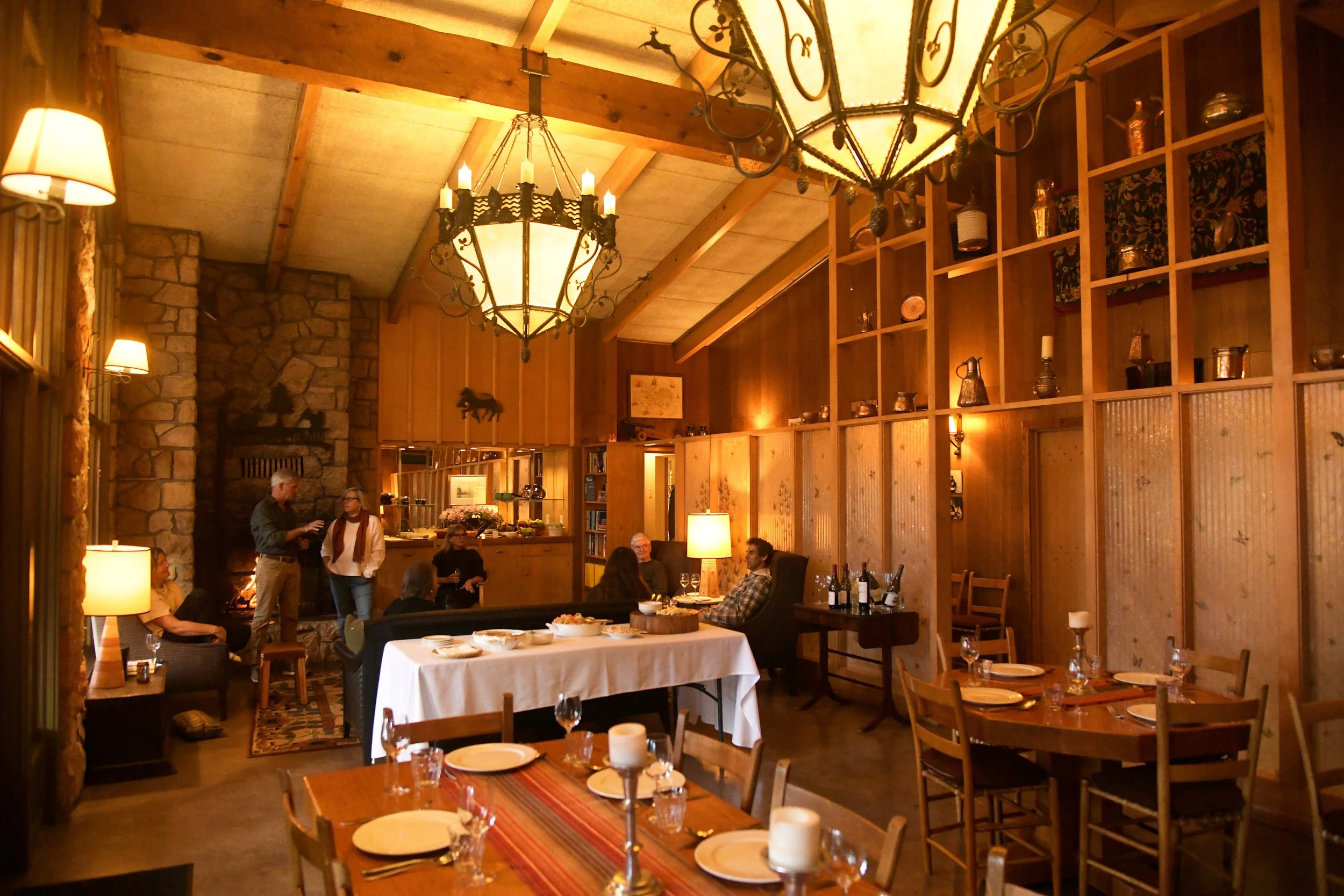
In the dining room, I found the workshop writers crowded around the table deep in discussion. These people had been strangers to each other, representing five decades and diverse professional backgrounds—engineering, journalism, social work, outdoor guiding, business, ministry. Now they leaned in close, their conversations lively and urgent; they just had so much to say to each other!
It surprised me, this enactment of community. I’d known House on Metolius would provide a beautiful and comfortable place for us to work. I’d hoped the material I’d prepared would inspire creativity in these writers. But I spend so much time alone, I’d forgotten about the power that people bring with them—to connect, to share, to offer each other the kindness of community. It was as if the workshop participants had conjured a unique genus loci in this place in our short time together.
I’ve been thinking about this for weeks now. Identifying our own essential landscapes is one thing. But what if we had the power to change the places we co-inhabit with others for the better? What if we had a shared essential landscape, a sense of genus loci for our communities, our country, our entire dear planet?
What do you think? Drop me a line if you care to share.
And if you’re interested in a retreat at House on Metolius, check out their plans for April with writer John Larison.
Writing Prompt: Essential Landscapes
What is the place that most grounds you, where you feel most yourself? Where does your genus loci live? It might be a house, a town, a trail in the woods, a foreign city you once visited or have only read and dreamed about. It could be a single room. Maybe it’s a place that is lost to you or imaginary. Describe this essential landscape with as much detail as you can. Walk into it. What do you see there? What does it smell like? What can you hear? What do you feel on your skin? Put out your hands—what do you touch? When you think of this place, what do you feel and where to you feel it in your body? Name the emotions this place brings up in you. Name the needs it meets. Why do you love it so and how does it love you back?
Photos from Rise Photography courtesy of House on Metolius